tvdxtips.com

Maintained by Danny Oglethorpe, member of Worldwide TV/FM DX Association.
MEXICO TV DX ID TIPS / PRIMER
DON'T BE FOOLED

DON'T BE FOOLED BY:


GENERAL INFORMATION
Typical TV station in Mexico

Although American TV viewers are accustomed to seeing/ hearing local IDs, news, and commercials regularly, local ID information is not common on most TV stations around the world--including those in Mexico. Mexico's network relayers have little in common with the average network affiliate in the United States. American network affiliates are generally full-power, full-service stations that run many local IDs, local newscasts, local weather reports, and local advertising. Mexico's network relayers, on the other hand, don't generally do anything more than repeat network programming 24/7. Most relayers are automated (unmanned) facilities consisting of satellite reception equipment to receive the network feed, a transmitter, a tower, and equipment to process the signal. Some of these repeaters also have equipment to insert local superimposed text IDs and local commercials. That is it: No studios, no local news, etc. Therefore, most of the IDs seen on many relayers are for the network-origination flagship stations in Mexico City.

  • LOCAL PROGRAMMING: A few network relayers air local news, local talk/variety programs, off-network syndicated shows, and full IDs at various times. Relayers with local programming that I have IDed include XHCH-2 Chihuahua, XHPVE-4 JAL (XHGC-5), XHAGU-2 AGS (XEQ-9), and XHTFL-5 Tepic NAY (XHGC-5). However, this is very rare.
  • Typical local ID on Mexico TV

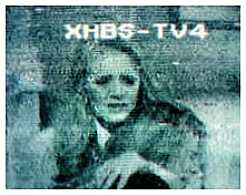
    The superimposed text ID is Mexico's most common type of local ID. They generally come up for a few seconds at thirty minute intervals, but not always on the TOH or half-hour. Watch for these IDs in the corners of the screen, as well as the top and bottom of the screen. The IDs can be as simple as "XHMEN-TV" or as long as four short lines of text listing calls, location, and time/date. These IDs are used by network relayers and some non-network independent stations. In addition to text IDs, independent stations air fancy animated IDs, local ads, and local news.

  • FULL IDS: In the past, a few XEW and Azteca-13 relayers have inserted full IDs (which sometimes feature fancy animation and music) into network programming once in a while. No IDs of this type were received by me in 2008-2009.
  • LOCATION IDS: Some TV Azteca relayers run full-screen ID slides or animated IDs which feature the station's location. For example, XHIT-4 airs IDs that read, "TV Azteca Chihuahua" (in addition to supered IDs).
  • ID locations: City of service or transmitter site?

    Many locations listed on supered text IDs are spots on mountains. Unlike TV station IDs in the US, which emphasize city of service, many Mexico TV IDs (like those in Europe) list the transmitter site location. These are some common ID locations: Las Lajas (Jalapa/Veracruz), Palma Sola (Tehuantepec OAX), and Cerro Burro MICH. Thanks to Jeff Kruszka for finding some of these locations.

    ID locations: More confusion

    MULTI-CHANNEL STATIONS (Same station, different channel) and MULTI-TRANSMITTER STATIONS (Same channel, different transmitter site): Due to Mexico's rough terrain in some areas, many local TV stations in Mexico have low-power and high-power relay stations (translators) in other cities (separated by mountains) on the same or different channels. Some of these stations insert a small local ID at the transmitter site listing that specific transmitter site, rather than carrying the key stations's ID. For example, XHWX-4 Monterrey has Monterrey listed on its ID as location, while related station XHWX-4 Saltillo has Saltillo listed on its ID.

    UNOFFICIAL STATIONS (or stations that nobody knows exist): Some network relayers are not on any official lists. These stations are generally connected to another, larger station on the same channel in a near-by city, generally separated by mountains. (See Multi-Channel Stations/Multi-Transmitter Stations, above.) Thanks to Fernando Garcia for confirming that these stations do indeed exist.

    Local TV commercials

    Local TV advertising is big business in the U.S. and Canada, but local commercials are few and far between on Mexico TV. Non-network independents run local ads, as do some big city network relayers. Network relayers in northern Mexico air more local ads than stations in southern parts of Mexico.

  • STATION BREAKS: There are no clear-cut station breaks on the networks, so stations insert local ads and IDs at various times.
  • Name vs calls

    It is common for stations in Mexico (especially non-network, independents) to use a name in addition to, or instead of, their call letters. Some station names and group names are listed below.

    • tele ver XHFM-2 Veracruz and XHAJ-5 Las Lajas
    • GDL XHG-4 Guadalajara
    • 4TV XHTV-4 Mexico City
    • RTV (Radiotelevision Veracruz) XHGV-4 Las Lajas VER
    • SIPSE XHY-2 Merida
    • Televisoras Grupo Pacifico XHI-2 Cd Obregon SON, XHQ-3 Culiacan SIN
    National news and sports

    There is no counterpart to the CBS Evening News or NBC Sports in Mexico. National news and sports programming is branded with the "Televisa" or "TV Azteca" names and logos, rather than "XEW News," "Canal de las Estrellas News," or "Azteca-13 Sports."

    Weekday newscasts on Mexico TV networks in Central Time:

    XEW
    0600-0900 Primero Noticias (N:1)
    1430-1500 Noticiero
    2230-2315 Noticiero

    Azteca-7
    2100 Hechos del 7

    Azteca-13 (except XHIT-4 Chihuahua, which airs all programs one hour behind)
    1500 Hechos
    2200 Hechos

    My observations and conclusions
    1. Most of the stations DXers receive from Mexico are network relayers, with most of those being relayers of XEW-2 and XHGC-5.
    2. It cannot be stressed enough that Mexico network relayers have very little in common with network affiliates in the United States. TV network and station operations, in general, are very different in Mexico.
    3. It appears that some network relayers do not use local supered text IDs or any other kind of IDs. That includes a number of relayers in large markets.
    4. It appears that some network relayers run little or no local advertising
    5. Some stations that usually run supered IDs (including XHQRO-2 Cancun, which runs many local ads) will go for days at a time without showing IDs. I don't know whether this is due to equipment failure, lack of interest on the part of technicians, or something else.
    6. Sometimes inserter malfunctions allow supered IDs to stay up for minutes, rather than the normal few seconds. I've seen the ID on several stations do this.
    Supered calls on a black rectangle.
    (XHCHF-6 Chetumal, QROO, as received and
    photographed by Jeff Kruszka in south Louisiana)
    GOVERNMENT AND UNIVERSITY STATIONS

    A DIFFERENT KIND OF STATION: These stations and mini-networks are owned primarily by state governments and universities. They run educational/cultural programming similar to the US PBS network. Some are independent, while others relay Mexico's ONCE network (see below). XHLQR-7 Chetumal QROO, for example, relays ONCE on a part-time basis. Mexico's educational stations generally air commercials. XHGV-4 Veracruz (RTV) and XHNQR-5 Cancun are the most frequently received stations in this category at my location.

    NETWORKS

    NATIONAL NETWORKS: Two companies operate Mexico's major national networks from Mexico City: Televisa and TV Azteca. There is also a small cultural/educational network known as ONCE. Televisa networks and TV Azteca networks display a small logo bug upper right during most programs. Once has a logo upper right contains difficult to read writting. It actually looks like a text ID.

    For more network information see Logos page


    SYNC BAR IDS: DON'T BE FOOLED BY SYNC BAR IDS. Some network relayers once had network IDs in the vertical synchronizing bar. These IDs usually listed the Mexico City flagship stations, in addition to the network name. These IDs were not generally local station IDs. Sync bar IDs are not being used as much as they were a few years ago.

    REGIONAL NETWORKS: Fernando Garcia has provided information about a regional network of Azteca-7 relayers (plus one Azteca-13 relayer) operated by TV Azteca Noreste. XHFN-7 Monterrey is the flagship station, and the network airs programs during the morning and midday hours. Local and regional news is aired on several stations in Nuevo Leon, Coahuila, and Tamaulipas under the name of "Info 7". Eskip target XHTAU-2 Tampico carries this programming. DON'T CONFUSE THIS AZTECA NEWSCAST WITH TELEVISA'S XEFB-2 MONTERREY. There may be other regional networks in Mexico.

    XHCSO-6 Cd Obregon SON (ID upper right). Photograph courtesy of Jorge Pinto.
    PROGRAM NOTES

    PROGRAM NAMES, ETC
    • Aqui en el 2 XHY-2 Merida YUC morning program airs 1000-1230 CT.
    • Primero Noticias (N:1) XEW-2 early morning news/informations program.
    • GDL Noticias XHG-4 Guadalajara newscasts.
    • Hechos TV Azteca newscast/information. Logo is a "H" in a circle. Local versions include "Hechos Chihuahua" (XHIT-4) and "Hechos Sonora" (XHHSS-4).
    • Hechos del 7 Azteca-7 newscasts with circle-7 logo.
    • Hoy XEW-2 morning variety and information show.
    • SNS XHQ-3 Culiacan SIN daily primetime newscast.

    (This type of ID is being phased out.)
    Supered calls without black rectangle.

    (XHBS-4 Los Mochis SIN)
    XHBS-4 supered calls
    Many thanks to the DXers and reporters who provided information to this site:
    • Tom Bryant, Nashville
    • Eric Bueneman (NOUIH), Hazelwood MO
    • Don Edwards
    • Fernando Garcia, Mexico
    • Glenn Hauser, Enid OK
    • Jeff Kadet, McComb IL
    • Jeff Kitsko
    • Jeff Kruszka, Baton Rouge
    • Jorge Pinto, Mexico
    • Kevin Redding, Mesa AZ
    • Doug Smith (W9WI)
    • Jorge Baez Tovar, Mexico
    • Steven Wiseblood, near Brownsville TX

    Rick Lewis of AZ also provided useful suggestions.

    Logos are property of Televisa, TV Azteca, ONCE, and other station owners.


    BACK